 TeamRally
Employee Happiness and Productivity: What the Link Actually Is
The happy-workers-are-more-productive claim is real but far weaker and more two-way than the statistics suggest — and productivity is the wrong reason to care.
You’ve seen the statistic. Happy employees are 13% more productive, or 20%, or 31% depending on which slide deck you’re looking at, and the citation is usually a link to another slide deck. It gets repeated because it’s useful: it converts something squishy into something a CFO can approve.
The underlying research is real. It’s also weaker, noisier and considerably more two-directional than the way it gets quoted — and building your case on it is a mistake for reasons that have nothing to do with whether the number is accurate.
Where the famous numbers come from
The most-cited recent source is a study of call centre workers at BT by researchers associated with Oxford’s Wellbeing Research Centre. Workers’ self-reported happiness was tracked weekly against sales performance, and happier weeks were associated with meaningfully higher sales — the figure usually quoted lands around 13%.
It’s a good study. Note what it actually measured: sales conversions, in a call centre, week to week, by the same people. Workers didn’t put in more hours when happier. They converted more of the calls they were already making, in a job where the output is a countable event and the emotional state of the person on the phone plausibly transmits down the line within seconds.
That is close to the ideal case for finding this effect. Whether the same coefficient survives translation to a backend engineer’s quarter, or a designer’s, or a strategy team’s, is not something that study can tell you — and it’s usually the step that gets skipped between the paper and the slide.
The broader picture is a modest correlation
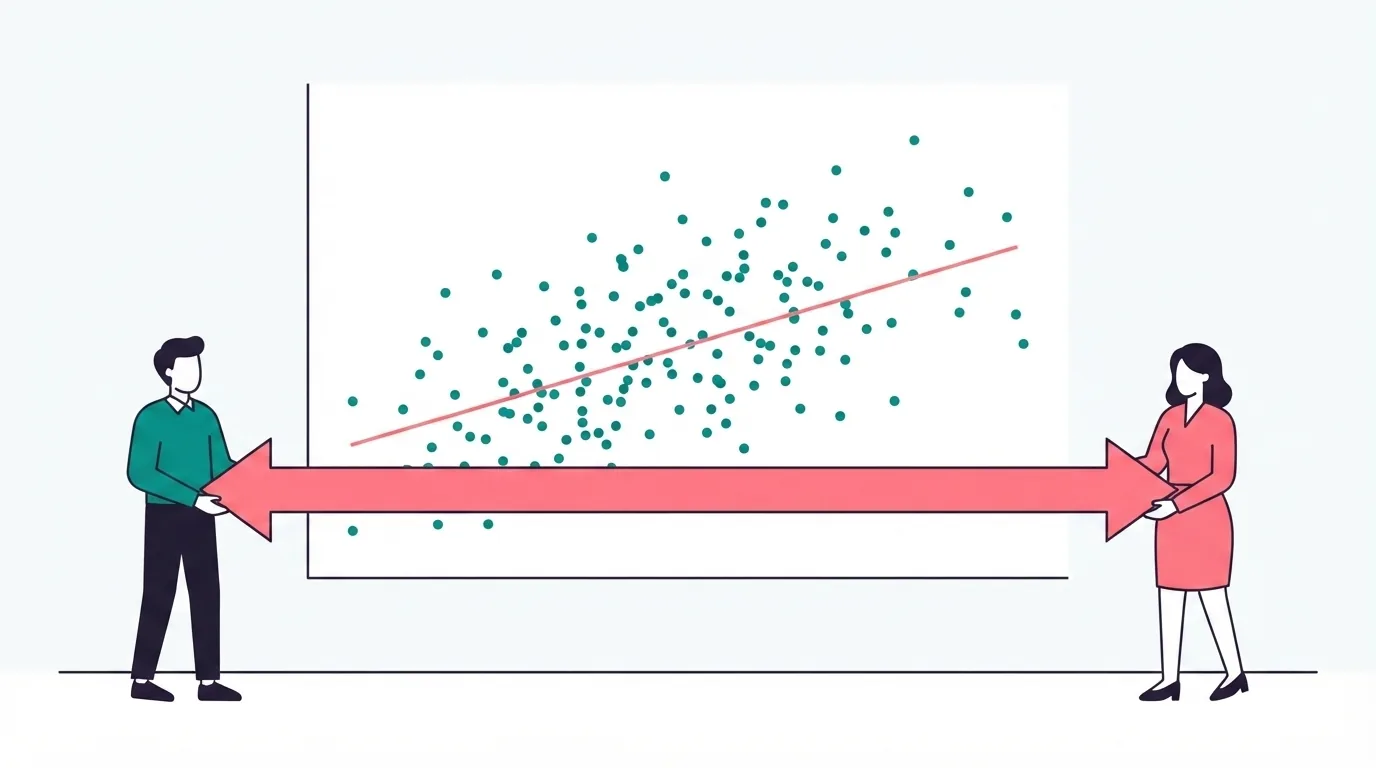
Zoom out to the meta-analyses and the picture cools considerably. The canonical one — Judge and colleagues, 2001 — pooled decades of job satisfaction and job performance research and landed on a mean true correlation of roughly 0.30.
That number is worth sitting with, because 0.30 sounds larger than it is. A correlation of 0.30 accounts for somewhere around 9% of the variance. The other ~91% is skill, tooling, management, clarity of task, team composition, luck, and the fundamental difficulty of the work. Happiness is in the model. It is not the dominant term, and no honest reading of that literature makes it one.
A modest, real correlation is genuinely the finding here. It’s just not a lever you can pull hard.
Which way is the arrow pointing?
This is the part most citations skip entirely, and it’s the most interesting question in the whole area.
There is good reason to think a substantial share of the relationship runs backwards. Doing work well is one of the more reliable sources of satisfaction available to an adult — competence is one of the three basic psychological needs in Deci and Ryan’s self-determination theory, alongside autonomy and relatedness. People who are performing well get better feedback, more autonomy, better projects, and more slack when something goes wrong. All of that makes them happier.
So when you observe that your high performers report higher satisfaction, at least three stories fit. Happiness caused performance. Performance caused happiness. Or a third factor — a competent manager, a well-scoped role, adequate tooling — caused both, which is my own guess at the largest single contributor.
Longitudinal and quasi-experimental designs help disentangle this, and the better ones do find some genuine forward effect. But the naive reading of a cross-sectional correlation — make them happy, get output — is asking one number to carry an argument it can’t support.
“Productivity” is doing a lot of work in that sentence
There’s a measurement problem sitting underneath all of this that rarely gets acknowledged.
Call centre sales are countable. So are support tickets, warehouse picks, and lines of insurance underwritten. Most knowledge work is not, and the proxies people reach for instead — tickets closed, commits, hours logged, story points — are so gameable and so weakly connected to value that they mostly measure activity.
Which produces a quiet selection effect across the entire literature. The studies that can measure productivity cleanly are concentrated in jobs with countable outputs, and those are systematically the most repetitive, most monitored, most emotionally demanding roles. It’s entirely plausible that the wellbeing–output link is genuinely strongest exactly there and much weaker in work where the bottleneck is thinking hard about a difficult problem. We don’t have great evidence either way, and the studies that would settle it are the hardest ones to run.
Add ordinary publication bias — a null result on this question is much harder to publish than a positive one — and the correct posture is real but unsettled, not established fact.
The business case backfires anyway
Suppose the numbers were rock solid. I’d still argue against leading with them, for a practical reason.
An instrumental case can be beaten by better instruments. If you justify celebrating people because it produces output, then you have invited the comparison — and someone will eventually run the numbers on whether a different intervention produces more output per euro. Sometimes it will. You have staked the thing on a metric that is not reliably on your side.
It licenses the wrong version of the activity. Once happiness is an input to a production function, the sensible move is to optimise it cheaply. That’s how you end up with points systems, badge economies, leaderboards, and mandatory fun — the efficient forms of the thing rather than the real one. Each of those is a rational response to treating happiness as an input, and each is worse than doing nothing.
And people can tell. This is the part that decides it. Recognition that exists because someone believes it will raise output reads differently from recognition that exists because someone noticed. Not always consciously, but reliably. The instrumental version tends to be generic, scheduled, manager-issued and faintly transactional, and the reason it doesn’t land is that everyone involved understands what it’s for. You cannot fake being noticed. The whole value of the gesture is that it wasn’t strategic.
What I think is actually true
Being reasonably happy at work is unlikely to make an average performer excellent. Being miserable at work will reliably make a good performer worse — through attrition, absence, withdrawal, and the ordinary difficulty of caring about something when you’ve stopped caring about everything around it.
The relationship is asymmetric, which is the practical version of Herzberg’s old distinction between the factors that cause dissatisfaction and the factors that create satisfaction. Misery has a large, fast, well-evidenced downside. Happiness has a modest, slow, contingent upside. Most of the available value is in not making people miserable, and that’s mostly about pay, workload, clarity and management quality rather than anything celebratory.
And then there’s the reason that doesn’t need a spreadsheet: people spend an enormous share of their waking life at work, and whether that time is decent is worth something in itself. That’s a sufficient justification. It doesn’t get stronger by being dressed up as an efficiency argument, and it doesn’t collapse when the efficiency argument is questioned.
So what should you do
Don’t build the internal pitch on a productivity multiplier. It’s shakier than it looks, and it puts you in a debate where the burden of proof sits with you and the evidence is genuinely mixed.
Retention is the honest business case if you need one. Turnover costs are large, well documented, and directly attributable in a way productivity effects aren’t — Gallup puts replacement cost at one-half to two times annual salary, and the recognition gap is one of the more fixable inputs to it. That argument survives scrutiny. The 13% doesn’t, quite.
Then do the thing for the actual reason. What moves the underlying experience is specific, peer-authored recognition and marking things that are genuinely true, at a cadence people can feel — not a points economy justified by a coefficient. If you want to track whether it’s working, measure it honestly and treat the result as a smoke alarm rather than a target.
No scores, no leaderboards, no productivity claims we can’t back. TeamRally runs your team’s celebrations and events, in one place. Free up to 15 people — start free.